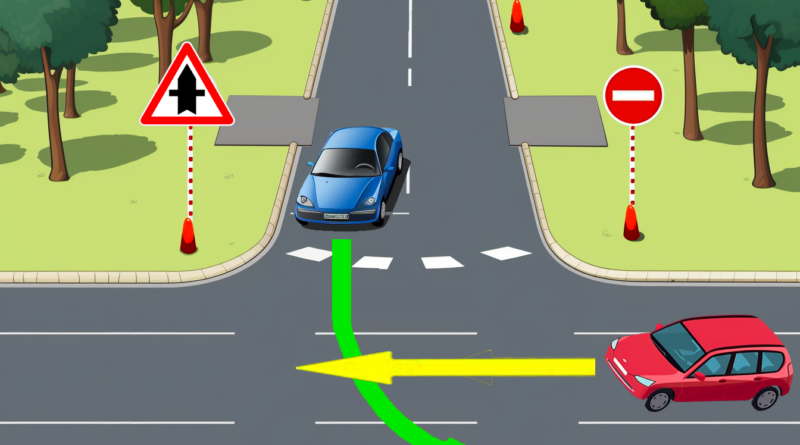
Which car has priority? Few people know the answer
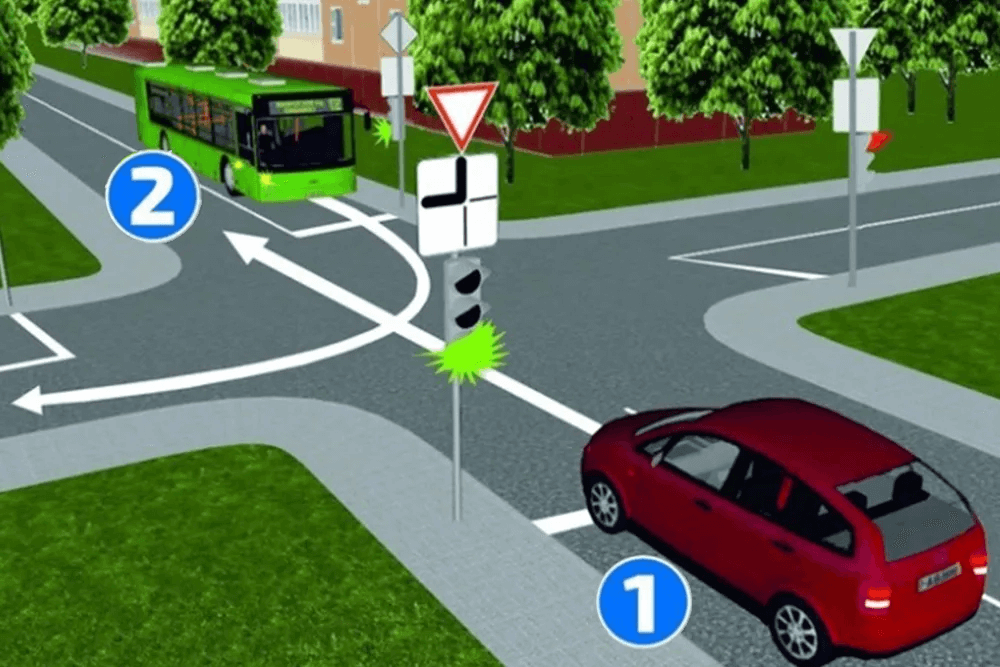
Do you know the answer to this question?
When you have been traveling for a long time, driving gradually becomes an extremely familiar habit. You may think that you already know how to handle most situations and have already encountered all the problems on the road. But let’s test this hypothesis with an example from a real driving test.
Look at the image above. A red car is approaching an intersection, as is a green bus. The green bus wants to turn right, while the red car wants to go straight. Which of the two vehicles has the right of way? Don’t forget that you have to take into consideration all signs, traffic lights and other conditions that may affect this traffic situation.
If you have already chosen an answer and want to check if you are right, click on the next page! There we will give you the right answer.
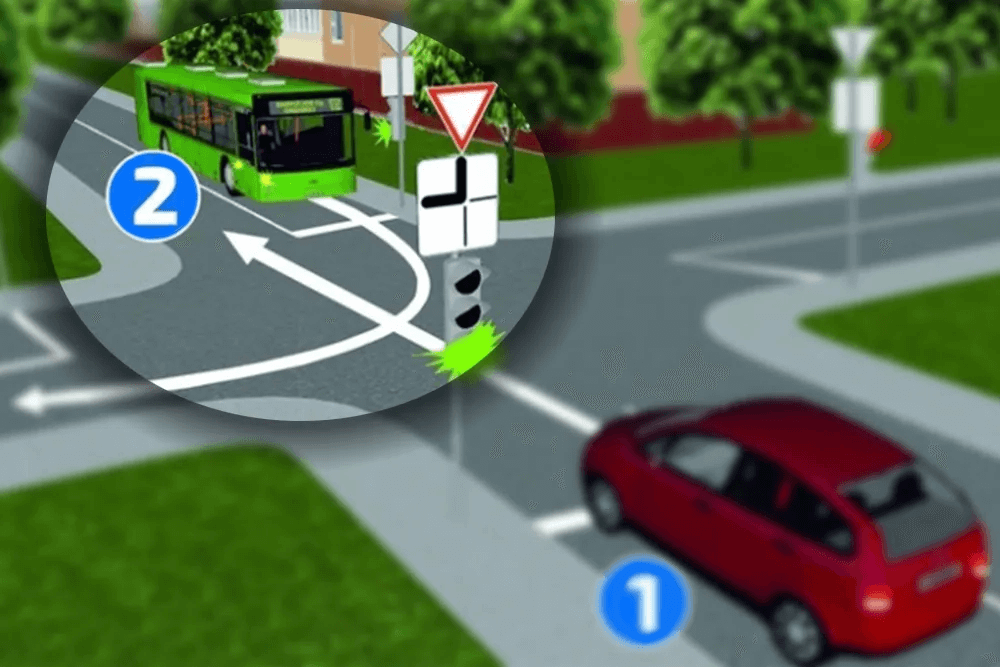
Which car has the right of way? Not many people know about it!
The right answer:
Which of the two vehicles now has the right of way and can continue without having to wait for the other? If you bet on the bus, you are right! Look at the white sign above the traffic light – it indicates that the bus has priority over other vehicles when turning.
Don’t worry if you answered wrong! Learning is a continuous process and every mistake is an opportunity to progress. Having dealt with the situation described above, you have gained valuable knowledge on how to deal with it. Are you ready for another challenge? Click on the next page, where another test awaits you!
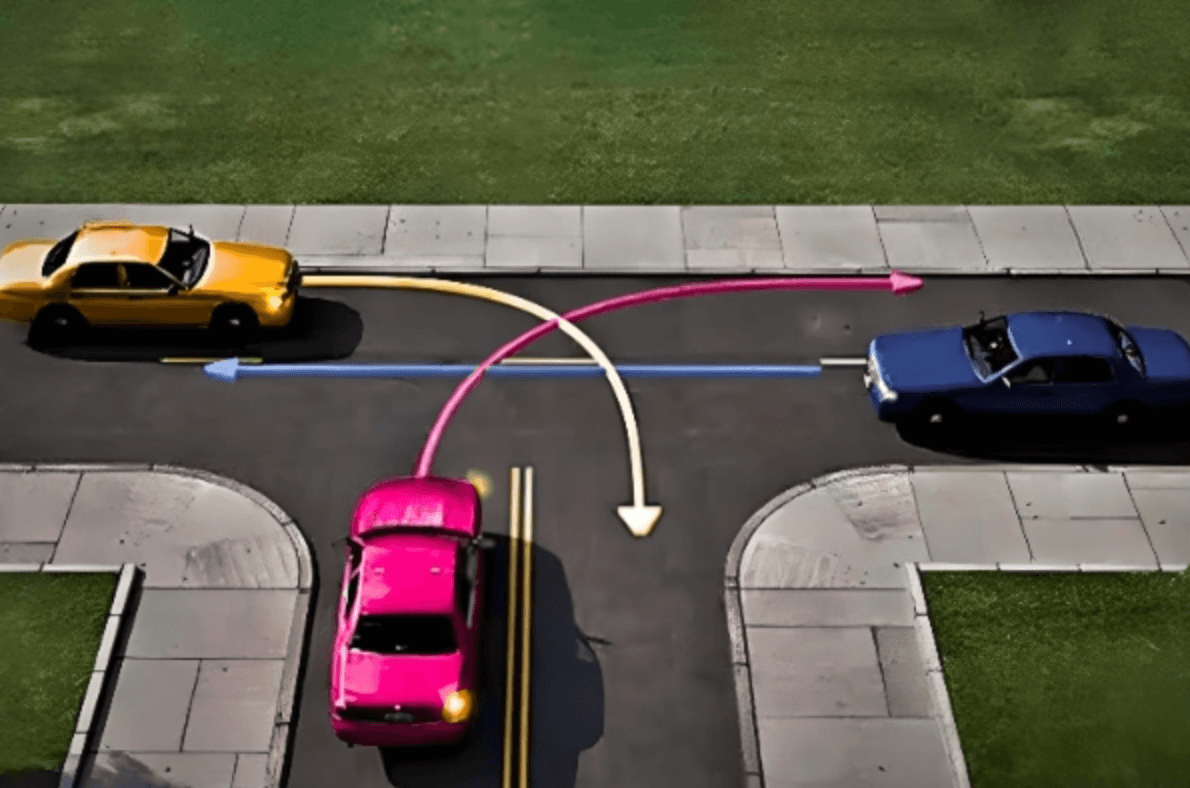
Take a look at the image above where 3 cars are involved at a T-intersection.
Do you have the answer to this question?
Examining the provided image, we can observe a traffic scenario at a T-intersection. In this situation, a red car is heading towards the intersection, accompanied by a yellow car approaching from the left and a blue car from the right. The intentions of each vehicle are as follows: the red car intends to make a right turn, the blue car plans to proceed straight, and the yellow car also wishes to make a right turn. Don’t forget to take into account all the signs, traffic lights and other conditions that may influence this traffic situation.
If you’ve already chosen an answer and want to check whether you’re right, click on the next page! There, we’ll give you the right answer.
The correct answer
In general, at a T-intersection where three vehicles are approaching, the right of way is typically granted to the vehicle on the through road, which is the one without the need to make a turn. In this scenario, the blue car that wants to go straight would have the right of way. After the blue car, the right of way would typically be granted to the yellow car that wants to turn right. In most jurisdictions, right-turning vehicles generally yield to oncoming traffic unless there is a specific traffic signal or signage indicating otherwise.
- The blue car, which intends to go straight, usually has the right of way at the T-intersection as it is on the through road and doesn’t need to make a turn.
- After the blue car, the yellow car, which wants to turn right, would typically have the right of way. Right-turning vehicles generally yield to oncoming traffic, unless there is a specific traffic signal or signage indicating otherwise.
- The red car, which also wants to turn right, would typically yield to both the blue car and the yellow car.
Can you provide the answer to this question?
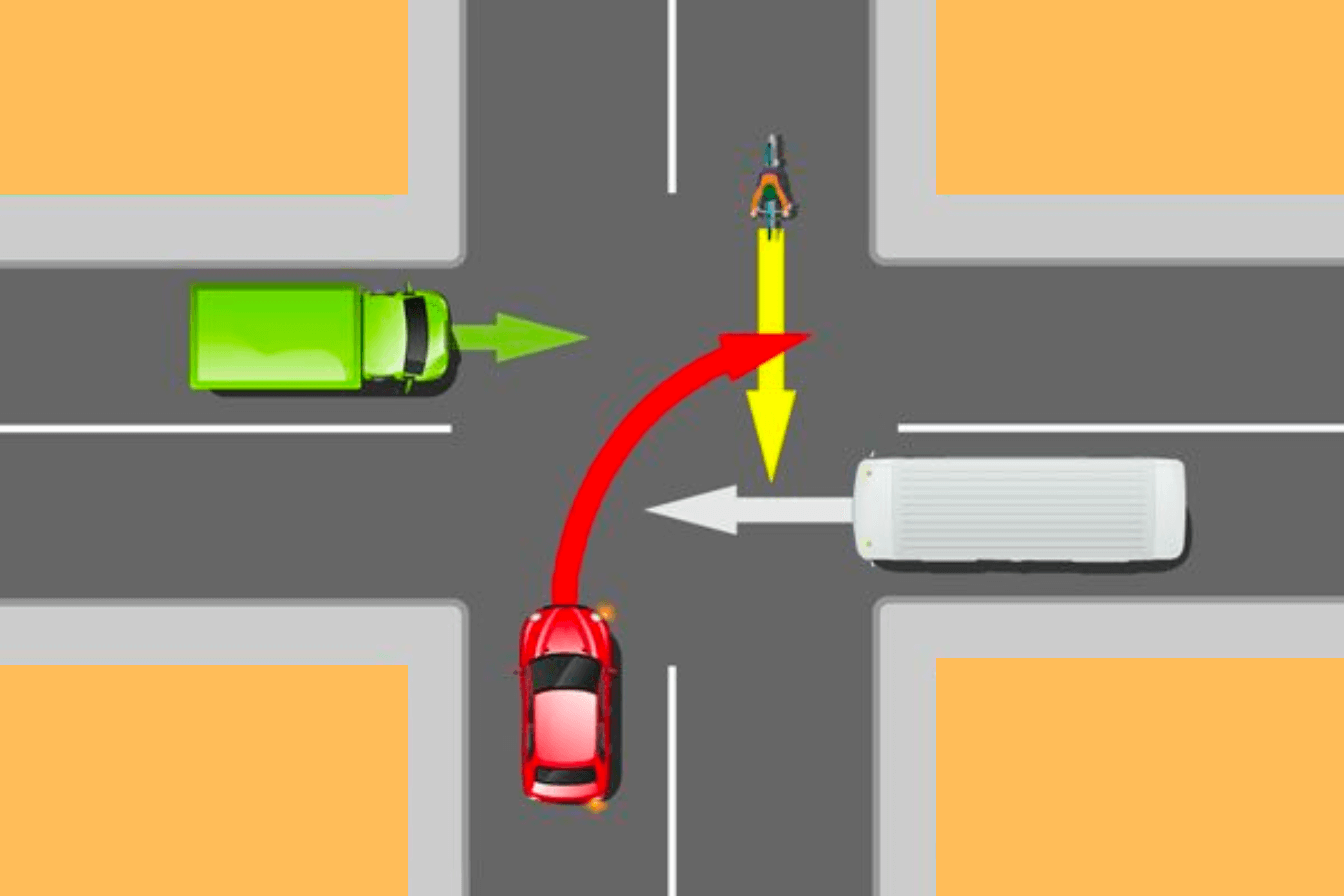
Examining the provided image, we can observe a traffic scenario at a four-way intersection. A red car is approaching the intersection, accompanied by a motorcycle from the opposite side, a green truck from the left, and a white bus from the right. The red car wants to turn right, while the motorcyclist wishes to go straight. The green truck and the white bus both aim to go straight as well. Considering general right-of-way rules, determine which vehicle, as depicted in the image, typically has the right of way in this four-way intersection situation.
If you have already made a selection and wish to verify if it is correct, proceed to the next page where we will provide you with the accurate answer.
The right answer
In this given scenario, we have a four-way intersection with a red car, a motorcyclist, a green truck, and a white bus approaching from different directions. The intentions of each vehicle are as follows: the red car wants to make a right turn, the motorcyclist intends to go straight, and both the green truck and the white bus want to proceed straight as well.
In general, the determination of right of way at a four-way intersection is guided by traffic laws and regulations specific to the jurisdiction. However, following common right-of-way principles, we can assess the situation as follows:
- The motorcyclist, who intends to go straight, usually has the right of way. Motorcycles are considered vehicles and are granted the same right-of-way privileges as other vehicles proceeding straight through an intersection.
- After the motorcyclist, the green truck and the white bus, both desiring to go straight, typically follow the right-of-way rules for vehicles on the through road. The specific right-of-way rules may vary depending on local regulations, but generally, the vehicle that arrives first or the vehicle on the left is granted the right of way.
- Consequently, the red car, wanting to make a right turn, would typically yield to oncoming traffic, including the motorcyclist, green truck, and white bus. It is customary for right-turning vehicles to yield to all oncoming traffic to ensure a safe flow of vehicles through the intersection.
Another tricky traffic situation, do you know the answer?
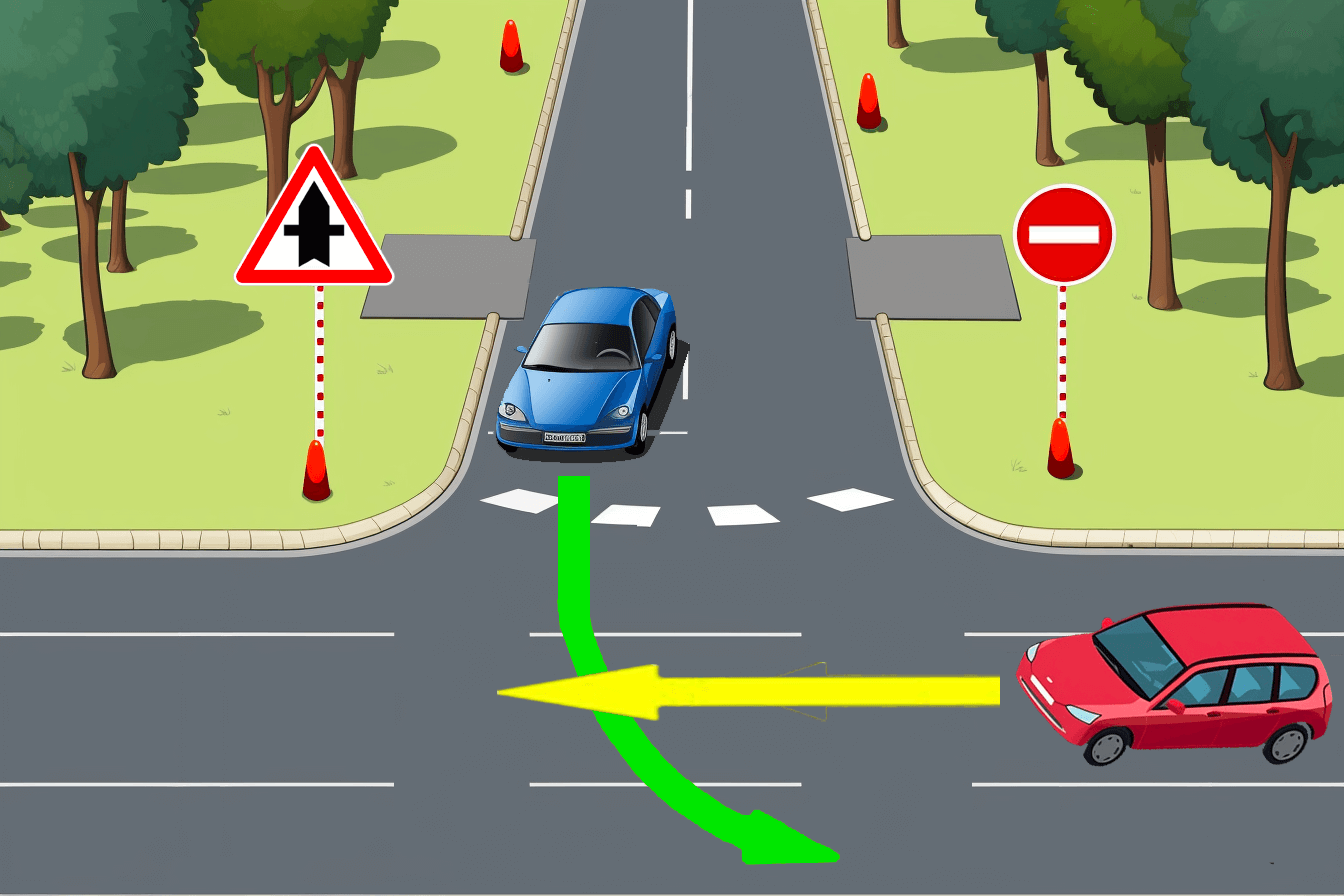
Two cars as well as road signs are involved at this T-intersection. The red car wants to continue straight on while the blue car wants to turn to the left. The situation seems simple at first glance, but have you noticed the two road signs? The first step to solving this situation is to identify the two signs and to figure out what they mean for each of the drivers.
Did you know there are over 500 official traffic signs? Knowing that it’s understandable that some of them may confuse you, it’s almost impossible to know them all. Luckily many of the signs are pretty self-explanatory. And if you’re really not sure it’s good to remember the four types of road signs:
The four categories of signs are:
- Regulatory Signs: Enforce traffic laws and regulations (e.g., stop signs, speed limit signs).
- Warning Signs: Alert drivers about potential hazards (e.g., curve ahead signs, pedestrian crossing signs).
- Guide Signs: Provide directions and navigation information (e.g., highway exit signs, destination signs).
- Informational Signs: Offer non-essential information and points of interest (e.g., rest area signs, tourist attraction signs)
Source: https://www.tips-and-tricks.co/various/left-carrules/